Cassettes, not ducts
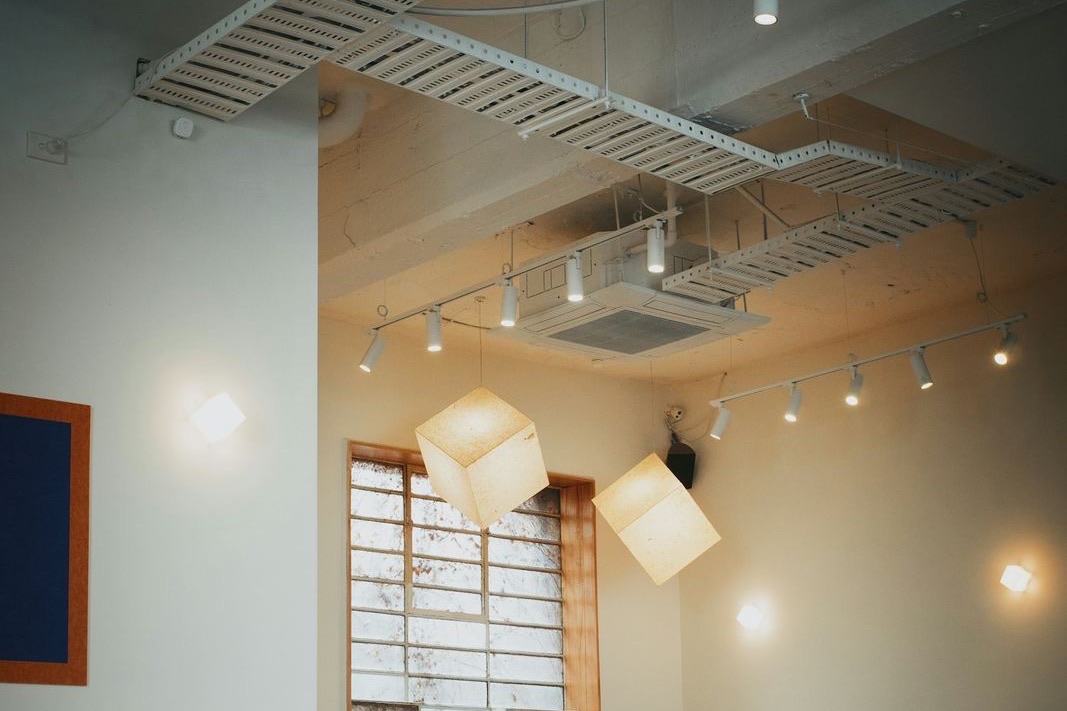
The grid ceiling was already there: the cassettes go in by lifting out tiles, with no grille work and no hidden unit.
In the afternoon the sun pours straight through the glass and the shop heats up just when it’s busiest. Here’s how two cassettes in the suspended ceiling sort it out. Sample job with sample data.
C-01 Premises data sheet
C-01.1 Installation plan
Each cassette covers half the shop and blows air out on its four sides. The pipes run through the suspended ceiling to the stockroom and up to the roof.
Example plan, not exactly to scale. On a phone you can scroll it sideways.
C-01.2 The calculation
It’s the same sum as the calculator. What weighs most here is the shop use and the west-facing glass.
C-01.3 The work
We measure up and check the suspended ceiling and the pipe route to the roof.
Two options in writing: cassette or ducted, with price and timescale.
With the shop open: roof, brackets, pipes through the stockroom.
A Monday with the shop closed: ceiling, vacuum, charge and test.
C-01.4 Decisions
The grid ceiling was already there: the cassettes go in by lifting out tiles, with no grille work and no hidden unit.
The window zone needs a lot more in the afternoon. With two, each works at its own pace, and if one fails the shop isn’t left without air con.
On the façade they’d bother the neighbours and make noise in the street. Up top they’re shaded by the roof structure and can be serviced without scaffolding.

C-01.5 Running costs
Ten hours a day, four months and electricity at €0.15/kWh. It’s an estimate using the calculator’s sum, not a bill.
Demonstration page prepared for Clima Nord. This is not the business’s official website.